

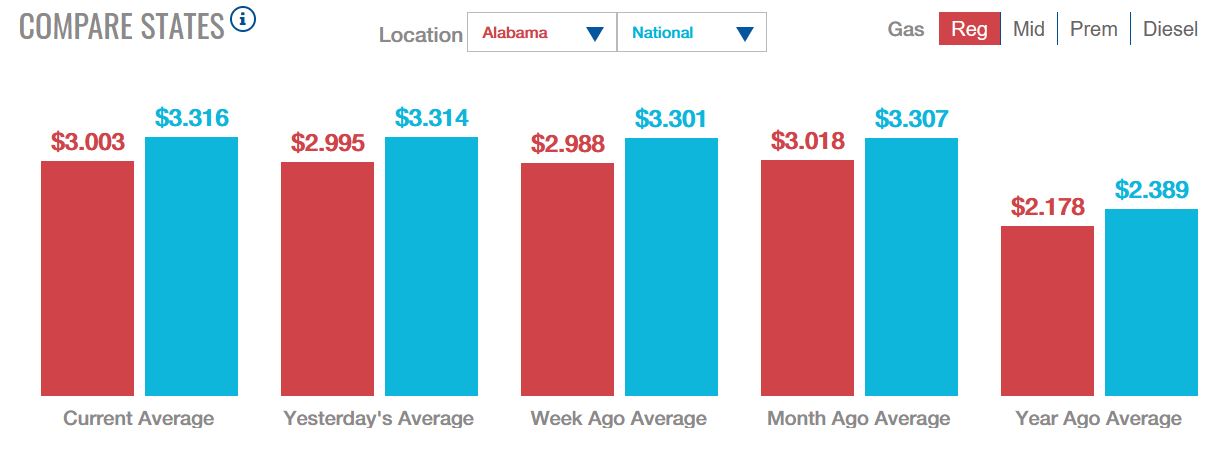
The average price for a gallon of gasoline in the United States is about $3.32. However, that average conceals a pretty wide range of prices across the country. For example, the state with the cheapest gas is Texas, where on average, consumers pay almost $2.95 per gallon. Conversely, the most expensive gasoline is found in California, with an average price of $4.65. Alabama is on the lower side with an average of $3.00. So why are gas prices so high?
 In 2019, the US average fuel price was $2.60 a gallon 54% of that went to the cost of crude oil, 18% went to state and federal taxes, 13% went to refining costs and profits, and 15% went to distribution and marketing. A closer look at the price of a single gallon of fuel can be even more revealing. It can reflect the number of refineries in a state and where it is in relation to the Rocky Mountains.
How The US Gets It Gas
The overall refinery count in the United States has shrunk dramatically over the last several decades. That means the country relies on an ever-smaller number of ever-larger plants and is more vulnerable to supply constraints in the wake of outages.
Gasoline is traded on the New York Mercantile Exchange, and spot prices for gasoline or futures contracts are a kind of benchmark for prices overall. But those prices can be quite different from what a consumer ends up paying at the pump. This is partly due to regional differences in gasoline availability, which heavily depends on how many refineries there are in a region, how productive those refineries are, and whether there is some event such as a refinery shutdown that is constricting supply.
The US is split up into five regions called petroleum administration for defense districts or PADDs for short. They were created by executive order in 1942 and were meant to manage the domestic petroleum supply distribution. They were used as districts for wartime rationing that ended with the end of World War Two, but they continued to be used as a system for collecting data about petroleum use around the country.

PADD 1 is made up of much of the East Coast (7 Refineries)
PADD 2 is most of the Midwest. (24 Refineries)
PADD 3 is the Gulf Coast. (52 Refineries)
PADD 4 is the Rocky Mountain region. (15 Refineries)
And PADD 5 is the West Coast which includes Hawaii and Alaska. (26 Refineries)
Petroleum can also be sent from one pad or region to another via a network of pipelines. So if there is an outage in the Midwest, fuel prices are liable to spike, but supplies can be sent from the East Coast or Gulf Coast as needed. If there’s a refinery outage in Chicago, the region can receive gasoline from the Gulf Coast in a matter of three to five days. However, the West Coast region is not so lucky primarily because it is cut off from the rest of the country by the Rocky Mountains.
Only one pipeline goes to the West Coast region from West Texas. So if a refinery in California goes down, there is no actual relief mechanism. The only real option for replenishment in the short term is shipping gasoline from Asia, often countries such as Singapore and Japan, which can take two to three weeks. This is quicker and more economical than sending gasoline from the Gulf Coast through the Panama Canal.
Risks of Decreasing Refinery Numbers
In recent years, there have been several notable outages of plants around the country that have caused price spikes in the summer of 2021. For example, extreme heat forced refineries to constrain production in the Pacific Northwest. There can be even more severe unplanned outages.
Hurricane Harvey in 2017 shut down a third of the country’s refinery capacity. The BP refinery in Whiting, Indiana, shut down unexpectedly in August 2015 in the middle of summer driving season, and basically, overnight gas prices shot up between 50 cents to $1 per gallon. Also, in 2015, an explosion at an ExxonMobil factory in Torrance, California, caused price spikes, as did a fire at a Chevron refinery in Richmond, California, in 2012.
Over the last several decades, the number of refineries in the US has shrunk. There are 129 operating refineries in the United States as of October 2021. This is down from 141 as recently as 2017. In 1982, the first year for which records are available, there were 254 refineries. This means the nation is becoming increasingly reliant on fewer and far larger refineries. In the future, petroleum analysts say the effects of a single outage will be amplified because each factory represents a larger percentage of total capacity. On top of these regional variations in refinery capacity, state taxes also account for differences in gas prices.
Gas Tax and How It Hurts Your Wallet
The federal gas tax has remained unchanged since 1993. And many have called for an increase to make repairs to highways. But 36 states have raised or reformed their gas prices since 2010. Just ten states have gone two decades or more without an increase. Alaska, for example, hasn’t raised its gasoline tax in 51 years. There is, however, quite a wide range between the lowest and highest tax states.
California, which has the most expensive gasoline in the country, also has the highest taxes. California’s average of about 85 cents per gallon; the national average is closer to 50 cents a gallon. California also has a carbon management program, which adds further costs. Furthermore, California requires a unique blend of fuel, which adds 10 to 15 cents in cost per gallon. When there is an outage, California supplies are difficult to replenish, in part because the state’s requirements are so strict.
Many refineries cannot produce gasoline that meets California’s standards, and if they do, they still need the bandwidth. The Nelson Complexity Index measures how sophisticated a refinery is and what kinds of products it can make out of oil. US refineries tend to rank the highest on the index overall, with an average rating of 9.5. Compared with European refineries with an average of 6.5. Any refinery making fuel that meets California standards would likely have to have a relatively high Nelson Complexity rating, and that could further restrict the number of suitable sources.
California Gas prices are higher than those even in Hawaii, where there is only one refinery, and the cost of living can be quite high. Many products need to be shipped to the string of islands. The San Francisco Bay Area is home to some of the highest gas prices in the country.
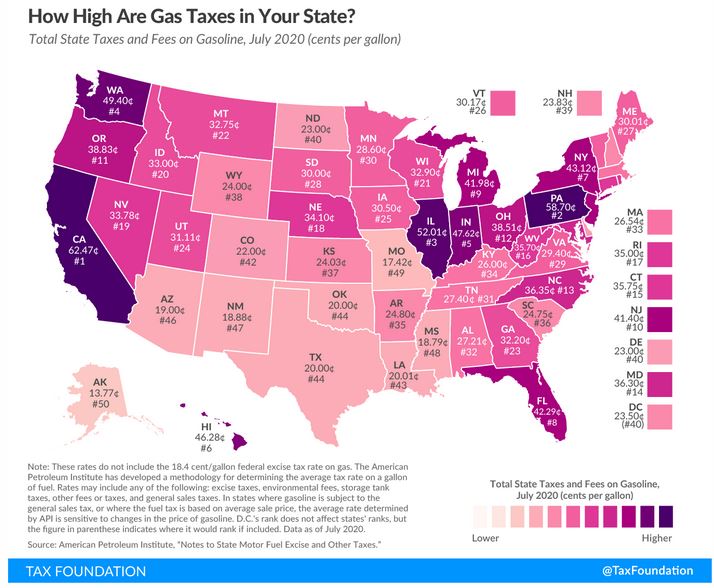 In general, lower tax states also have lower gasoline prices. Alaska, which is one of the most oil-rich states in the US, is an exception to this rule. It has very low gas taxes, 13.77 cents per gallon, but its far northern location, climate, geography, sparse population, and infrastructure mean that producing gasoline is significantly more expensive. Alabama’s tax is 27.21 cents per gallon. These numbers do not include the federal excise tax on gas which is 18.4 cents per gallon.
Some kind of federal carbon tax, for example, could be in the country’s future. Some Democrats wanted to add one to their proposed $3.5 trillion budget bill in September of 2021.
COVID Created Massive Supply and Demand Imbalances
2020 and 2021 have created some unusual effects, including rapidly rising fuel prices in many parts of the country.
Well, Covid is the bulk of the reason why prices have accelerated so much in the last six months. And it’s because America has been getting back to normal. Early in the pandemic, gasoline demand dropped dramatically as workers were told to stay home.
You’ll remember early on in the pandemic, there was a massive behavior change. American stopped filling up for several weeks. As a result, gasoline demand plummeted some 60%, and along with that, the price of oil went into negative territory for the first time. As a result, oil companies scaled back the production of crude oil; they scaled back gasoline production.
Those are permanent and long-term changes.
In 2020, several refineries closed in the western United States, which reduced refining capacity. That was combined with some demand spikes as people stuck in their homes for months sought to get out of the house and take trips. These unusual circumstances have produced huge variations in wholesale prices between the western and eastern US.
But there are longer-term effects of this that couldn’t playout for the rest of the decade. So oil companies again made long-term decisions, they shut down production, they laid off 10s of 1000s of workers to try and stay alive during the pandemic, and now it’s the fact that demand has come back so quickly. That is pushing gas prices up to some of these seven-year levels.
I think a lot of this is transitory. It’s a kind of a new norm as things smooth out in the future. So I guess we will see prices again go down or if we have to start thinking about driving more fuel-efficient vehicles to save at the pump.
We have a good number of vehicles that fit that and are available. Check them out here.
Connect with us


Recent Blog Entries
- Cybertruck vs. Chevrolet Bolt EV: Who Says You Need a Truck to Get the Job Done?
- Used BOLT EVs – Over 30 All Priced Under $20,000 – Most Qualify for $4,000 EV Tax Credit
- Stable Gas Prices: A Surprising Trend for the Season
- Cars Built for the Long Haul: A Glimpse into Vehicles that Stand the Test of Time
- Auto Industry Trends We Just Can’t Get Behind